
Featured Trip - 14 Days Kanchenjunga South Base Camp Trek -
Explore More
Join the Himalayan Dream Team for an unparalleled adventure in the heart of Nepal's Everest region on the Everest Three High Passes Trek. This challenging trek takes you through three high-altitude passes—Renjo La (5,465 meters), Cho La (5,420 meters), and Kongma La (5,535 meters)—each offering breathtaking views of the towering Himalayas, including Mount Everest, Lhotse, and Makalu. Designed for seasoned trekkers, this journey promises not only physical challenge but also unmatched scenic beauty.
The trek is a less crowded alternative to the popular Everest Base Camp trek, guiding you through secluded communities, lush forests, and stunning high-altitude valleys. The panoramic vistas of the Himalayas and the serene Gokyo Valley are truly mesmerizing. Highlights of the trek include stops at Everest Base Camp, Kala Patthar, and Gokyo Ri, each providing unique and unforgettable views that will stay with you long after the trek is over.
Cultural immersion is a significant aspect of the Everest Three Passes Trek. As you traverse through iconic Sherpa villages like Phakding and Namche Bazaar, you’ll have the opportunity to experience the rich traditions and hospitality of the Sherpa people. Visits to remote villages and ancient Buddhist monasteries offer deep insights into the local culture and spiritual practices, enhancing the overall trekking experience.
The journey begins with a scenic flight from Kathmandu to Lukla, setting the stage for the adventure ahead. From lush forests to high-altitude landscapes, every step of this trek reveals new wonders. Whether you’re standing at the top of a high pass or interacting with the local Sherpa community, the Everest Three Passes Trek is a journey of discovery and awe, promising memories that will last a lifetime. Join the Himalayan Dream Team and create a special place in your life with this unforgettable adventure through Everest’s majestic landscape.
Arrival in Kathmandu and transfer to the hotel Welcome to Nepal! A Himalayan Dream Team representative will welcome you with a Nepali flower at Tribhuvan International Airport in Kathmandu and facilitate your private transfer to the hotel. You can relax and recover from your journey at the hotel and, when you feel ready, enjoy a gentle stroll around the neighborhood to get your first taste of the city. As an introduction to your journey, we would like to treat you to dinner at one of best restaurant, which is guaranteed to give you the best impression of authentic local cuisine and hospitality.
Your adventure officially begins! Depending on the season, we either fly directly from Kathmandu or drive to Ramechhap for a short Lukla flight. The journey offers mesmerizing views of verdant hills, terraced fields, and the snow-capped Himalayan skyline. Upon landing in Lukla, we meet the trekking team, enjoy a brief rest, and set off on our trek to Phakding. The trail meanders through Cheplung village, offering a glimpse of the revered Mt. Khumbila, untouched by climbers.
Kathmandu to Lukla Flight: 35 minutes (off-peak months: Jan, Feb, Jun–Sep, Dec).
Manthali to Lukla Flight (Peak Season): 5–6 hrs drive to Manthali, 20 mins flight, 3–4 hrs trek.
Peak Season (Mar, Apr, May, Oct, Nov): Early morning drive to Manthali (1:30–2:30 AM) for a 20-min Lukla flight.
Non-Peak Season (Jan, Feb, Jun–Sep, Dec): Direct 35-min flight from Kathmandu to Lukla.
For a smoother start, book a direct helicopter flight from Kathmandu to Lukla at $550/person (5-person sharing basis) to skip the long drive to Manthali during peak season.
Trekking Time: Approx. 3–4 hours from Lukla to Phakding.
We start early, trekking along the Dudh Koshi River through a scenic pine forest towards the small village of Benkar. Enjoy breathtaking views of Thamserku peak towering above the valley. Cross a long suspension bridge shared with donkeys and mules carrying trade goods.
Continuing to Monjo, take in views of Khumbila peak. Monjo is the gateway to Sagarmatha National Park, where you'll need to show your permits and purchase an entrance ticket at the checkpoint. Descend to the river and cross a suspension bridge to Jorsale village, where you catch your first distant glimpse of Mt. Everest.
After lunch in Jorsale, the trek continues through a steep forested area until reaching the confluence of the Bhote Koshi and Dudh Koshi rivers. Before arriving at Namche Bazaar, the trail ascends to Tope Danda, a vantage point offering expansive views of Namche town. Upon reaching Namche Bazaar, head to a tea house, relax, and enjoy some local butter tea.
Namche Bazaar, the bustling hub of the Khumbu region, is a key meeting point for trekkers and mountaineers. This vibrant town is filled with locals and traders, especially on Saturdays when a lively market takes place. With numerous ATMs, cyber cafes, shops, bakeries, and restaurants, you can enjoy a taste of home with pizza and espresso.
On your acclimatization day, enjoy a hearty breakfast before opting for a hike to nearby attractions. Visit the renowned Khunde Hospital, established by Sir Edmund Hillary, and explore Namche Monastery to delve into Buddhist heritage. Hike to the Everest View Hotel for stunning, close-up views of Mt. Ama Dablam and Mt. Everest. This day offers a perfect blend of rest and exploration, preparing you for the trek ahead.
Tengboche (or Thyangboche) is a village in Khumjung. The trek to PhunkiThanga is an easy walk. From there, we ascend to Tengboche village, home to the famous Tengboche Monastery, the largest in the Everest region. It sits within Sagarmatha National Park, a UNESCO World Heritage Site. The monastery offers stunning views of the Himalayas, including Mt. Everest, Nuptse, Lhotse, Ama Dablam, and Thamserku. The monastery opens at 3:00 pm, so arriving by then allows us to witness a Buddhist religious ceremony.
After that, we'll go to Tengboche. We'll check in at our guesthouse and then explore the area. One of the top places to visit is the Tengboche monastery. It's the biggest monastery in the Khumbu region and sits among the beautiful Himalayan mountains. Inside, there are lovely murals and sculptures to see. After our visit, we'll go back to our lodge and spend the night in Tengboche.
From Phorse Village we trek down the narrow trail through a Monastery. We continue our trek through lush alpine forests until we reach large village of Upper Pangboche, where we will get astonished by the dramatic views. We then continue through the villages of Shomare, Orsho, and Tsuro Wog. The trek goes further up through the Khumbu Khola Valley to the ridge top from where we witness spectacular views of the soaring mountains of Taboche, Ama Dablam, Thamserku, Nuptse, Lotse, Cholatse, etc. We even can observe the beautiful Imja Khola valley to the east. Thereafter, we see sprawling fields and the settlement of Dingboche overlooked with Chortens and prayer flags as we gently ascend down to the Dingboche village.
From there, we'll continue our ascent through the Khumbu region, reaching Dingboche after about five hours of trekking. Upon arrival, we'll drop off our bags, kick off our boots, and indulge in a satisfying home-cooked meal at a local guesthouse before calling it a night.
Spending a day in Dingboche to acclimate to the high altitude is on today's schedule, helping us adjust to the thinning air and reduced pressure. Though not mandatory, a recommended acclimatization strategy includes a side trip to Chhukung at 4730m. This involves a short hike eastward up the Imja Khola valley, offering stunning views of Lhotse, Ama Dablam, and Island Peak. Alternatively, we can climb the ridge above Dingboche as another option.
Trek to Chhukung, a quaint settlement used as a staging point for further ascents. Post-lunch, attempt the climb to Chhukung Ri, a peak that provides exceptional views across the valley to Ama Dablam and Amphu Labcha peaks. This day tests your endurance and rewards with breathtaking panoramas.
Embark on one of the most challenging days, crossing the Kongma La Pass, the highest of the three passes. This route involves a steep ascent followed by a descent to Lobuche, where the effects of high altitude are mitigated by the stunning landscape of the Khumbu Glacier.
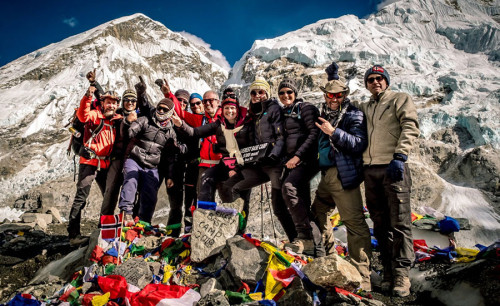
Trek towards Gorak Shep, the last stop before reaching the Everest Base Camp. Traverse rocky and glacial trails before finally stepping onto the iconic base camp, a dream for many trekkers. Absorb the surreal environment and celebrate this significant achievement. Return to Gorak Shep for an overnight stay
An early start to climb Kala Patthar for a sunrise view over Mt. Everest. This spot offers one of the best vantage points for Everest views. Later, descend to Lobuche for the night, reminiscing about the morning's golden sunlit peaks.
The journey continues as you head to Dzongla, another beautiful spot that offers unique views and a quieter trail compared to the earlier days of the trek.
Cross the Cho La Pass, your second high pass, which involves navigating through steep trails and rocky paths. The effort is rewarded with the arrival at Gokyo, a serene location with emerald lakes and a spectacular glacier view
Utilize this rest day by climbing Gokyo Ri for panoramic views of the grandeur that is Everest, Cho Oyu, Lhotse, and beyond. Also, explore the series of Gokyo Lakes, each offering tranquil settings and photogenic landscapes
The final pass, Renjo La, offers yet another perspective of the Everest region, with expansive views that are starkly different and spectacular. Descend to Lumde, marking the conclusion of pass crossings.
Begin your return trek, descending to Namche Bazaar. This day allows for reflection onthe journey as you retrace steps back through familiar landscapes.
Your final trekking day leads you back to Lukla, where the loop of your journey closes. Celebrate the last night of your trek with your crew, reflecting on the remarkable adventure.
Fly back to Kathmandu, enjoying the last glimpses of the mountains from above. The rest of the day is free for relaxation or souvenir shopping, followed by a farewell dinner to celebrate the successful completion of your journey.
A buffer day in Kathmandu to accommodate any delays from Lukla and to explore more of the city's cultural sites
Transfer to the airport for your departure flight or consider extending your stay to explore more of Nepal’s wonders.
Optional tours to places like the Chitwan National Park can be arranged for continued adventure.

The Everest Three Passes trek includes the Kongma La Pass (5,535 m), Cho La Pass (5,420 m), and Renjo La Pass (5,360 m).
This trek is considered challenging due to its high altitudes, steep climbs, and the length of the trek. It's suitable for physically fit individuals with prior trekking or mountaineering experience.
The Everest Three Passes trek typically takes about 18 to 21 days depending on the itinerary and pace of trekking.
The best times to undertake the Three Passes Trek are during the spring (March to May) and autumn (September to November) seasons, offering more stable weather conditions and clearer views.
Yes, due to the challenging nature and remote paths, hiring a guide is highly recommended for safety reasons and for better navigation through the passes.
You will need the Sagarmatha National Park permit and the Trekkers' Information Management System (TIMS) card. Your trekking company can arrange these for you.
Similar to the Everest Base Camp trek, accommodations are primarily in teahouses which offer basic facilities and meals.
Mobile coverage is sporadic and not reliable. Some villages may have Wi-Fi available for a fee, but it's best to prepare for limited communication.
Essential gear includes thermal clothing, waterproof jackets, sturdy trekking boots, sleeping bags suitable for low temperatures, a first-aid kit, and a headlamp. Consider carrying trekking poles and ice axes for the passes.
The main risks involved in the Three Passes Trek include altitude sickness, unpredictable weather changes, and icy or slippery paths. Adequate preparation and acclimatization are key to managing these risks.
Costs can vary widely, typically between $1,500 and $2,500, depending on the trekking agency, group size, and services included.
Engage in cardiovascular activities such as running, swimming, or cycling. Also, practice hikes that include long duration walks on uneven terrain to build stamina and muscle strength.
Yes, obtaining travel insurance that covers high altitude trekking up to 6,000 meters, medical expenses, and emergency evacuation is crucial.
Teahouses along the trek offer a mix of local and international cuisines but primarily serve simple, high-carbohydrate foods like dal bhat, noodles, and soups which are ideal for high-energy trekking days.
Be mindful of leaving no trace. Carry all non-biodegradable materials back with you or dispose of them properly at designated facilities. Use water purification tablets to minimize the use of plastic bottles.
Enjoy the popular trekking and tour packages in Nepal Himalayas. 2026.




© 2011 - 2026 All rights reserved. Himalayan Dream Team